
In our latest episode of Jobshare Stories, Chloe spoke to Felicity and Corrie, who jobshare the role of Programme Director for the school-based nursery capital programme at the Department for Education. Both built their careers in demanding, high-pressure environments, including counter-terrorism at the Home Office, which is where they first came to know of each other. Seven years and several roles later, theirs is one of the most intentional partnerships we’ve come across. It’s also a brilliant example of jobsharing as a genuine leadership accelerator.
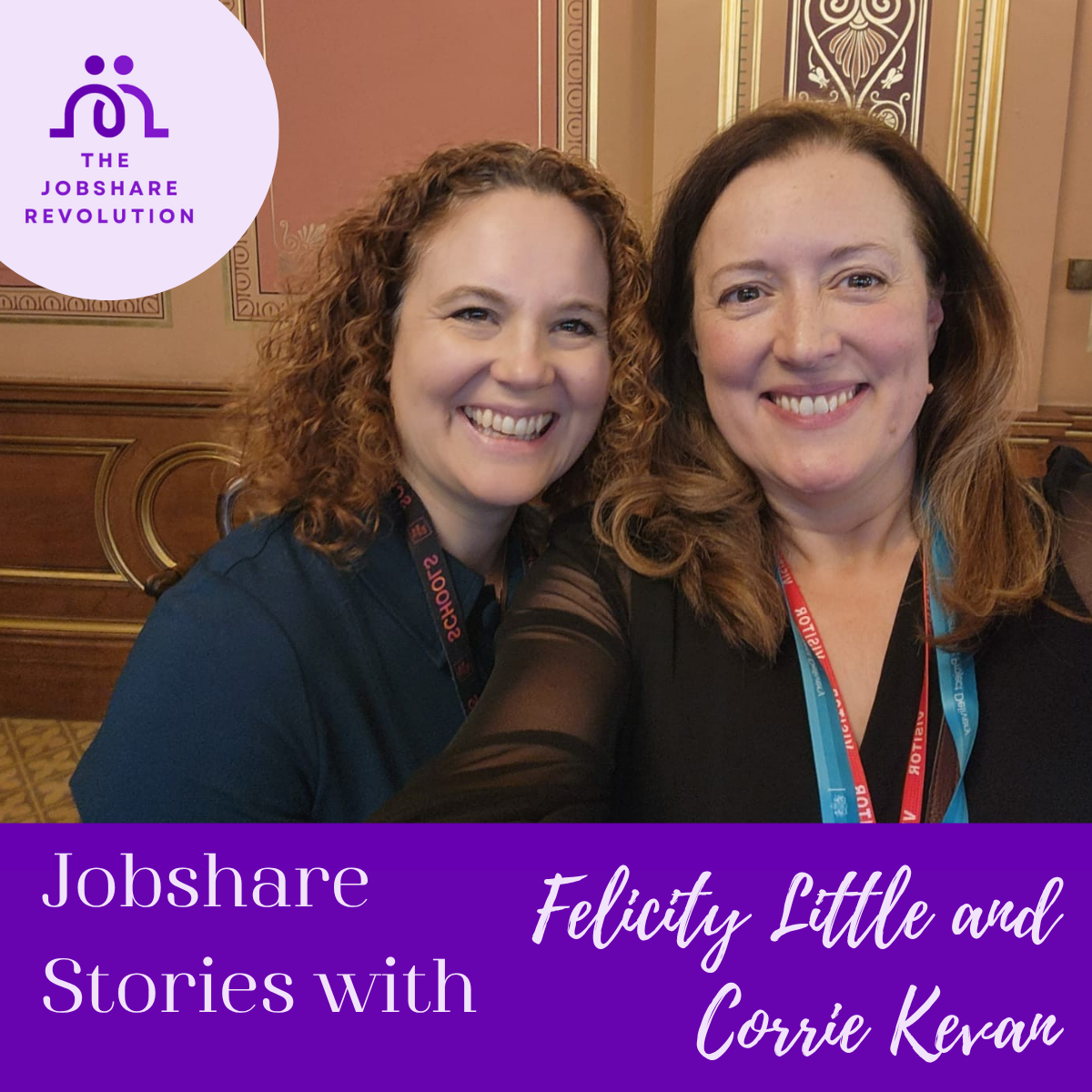
Felicity Little & Corrie Kevan - Programme Directors, School-Based Nursery Capital Programme, Department for Education
Finding each other
Felicity and Corrie didn’t start their jobshare after years of working side by side. They knew of each other from the Home Office, then found one another as prospective partners through a civil service jobshare matching tool. From there, they applied for a role together at the DfE, and got it.
That first role was in initial teacher training policy, and much of their partnership was forged during COVID, when they were responsible for making sure teachers could still be trained and qualified. At home, the jobshare meant they could swap around who was homeschooling and who was working.
“It was real practical and emotional support through quite a tough time.”
Since then, they’ve moved through a series of increasingly senior roles to their current heavy-delivery programme, which they both say is their favourite so far.
Intentional from day one
What really stands out about Felicity and Corrie’s story is how deliberately they built their partnership, before they had even met.
Felicity did her homework, quietly asking around to check that Corrie would be a good fit. As Corrie put it:
“Felicity did some real due diligence on me and asked around to see if I was a reasonable prospect and a good person… We really had to anchor that to our values and start from there. And everything we’ve done since has grown from that.”
They also exchanged honest questions about their values, their red lines and their personal circumstances. These are the conversations most new pairs are far too polite to have. Felicity is unapologetic about it:
“You have to ask some really personal questions. I say this to everyone and people are a bit horrified, but you ask things like, do you think you want any more children? Because that is an impact for the rest of your career… you need to know if you’re both roughly on the same page.”
It’s advice we wholeheartedly agree with. The single most important thing in any jobshare is the relationship between the pair, and that relationship is far stronger when it’s built on honesty from the very start.
The practical craft of a great jobshare
Felicity and Corrie have also developed some lovely practical habits that other pairs could easily borrow:
· An unusual split. Rather than the more common two-and-a-half days each, they work a four-day/three-day pattern, which works for them and for the role.
· No more Sunday-night calls. Instead of the dreaded weekend catch-up, they hand over in OneNote, so everything is captured, searchable and there when it’s needed.
· A “positive praise” ritual. Every handover includes something written that each thinks the other did really well that week. Writing it down makes feedback feel less confrontational and builds in time for reflection.
Standing together — no apologies, no ego
If there’s one piece of advice from this episode that every jobsharer should take on board, it’s this one from Felicity:
“Don’t apologise for being part of a job share… there’s no better way to undermine your personal credibility or your credibility as a pair.”
Felicity and Corrie stand as one unit, always. Wins are shared, and so are mistakes. They also follow a ground rule borrowed from another jobshare, and one Chloe and Laura have always lived by too: don’t argue in front of the kids. Disagreements happen behind closed doors. Their team should never have to navigate them.
“We have always said we stand together. If one of us makes a mistake, both of us. If one of us does something great, it’s both of us. And that’s how we roll.”
None of this works without leaving your ego at the door. That point was made rather charmingly when Felicity admitted they “epically fail” the personality questionnaires on senior leadership courses: “I think it’s because we don’t have any ego. For us it’s about the job.”
A coach on your shoulder
Both are clear that the partnership has made them more resilient, at work and at home. For Felicity, jobsharing means she can be the best she can be with her family as well as in her role. It creates, as she puts it, “a more multifaceted life.”
For Corrie, it’s the built-in reflection that makes the difference:
“It makes me better at my job, because I really have to think through, why am I doing this? How will I explain to Felicity that I’ve done it?… It provides a voice on my shoulder that I need sometimes.”
And the relationship runs deep. Felicity describes their partnership as the second most important relationship in her life. When something difficult happens, Corrie is often the first person she tells.
Learning to let go — and becoming better leaders
Perhaps the most powerful part of their story is how jobsharing changed the way they lead. Both describe themselves as natural completer-finishers, so learning to trust, delegate and let go didn’t come easily.
“As a natural perfectionist, control freak and obsessive completer-finisher, I thought I would never be able to jobshare… but I did learn it. And because of it, that has made me a better leader.”
That lesson has spread to how they lead their team. As Corrie reflected, once you learn that your partner can pick up a piece of work and do it just as well, maybe even better, you start to see the same in the people around you:
“You should release them. It’s very freeing and a really empowering state of mind.”
Don’t smooth out the differences
Rather than trying to become the same person, Felicity and Corrie deliberately lean into how different they are. Corrie’s top tip for new pairs:
“Don’t smooth out the differences between you… It’s fine to have your own approach to problem solving. Those differences can really bring value to your work.”
It’s a reminder that a jobshare isn’t about cloning yourself. It’s about bringing two complementary sets of strengths to one role, because 1 + 1 really is greater than 2.
The honest trade-offs
Felicity and Corrie are also refreshingly honest that jobsharing isn’t for everyone. You probably work harder. You rarely get to see a piece of work through from beginning to end. And it simply won’t work for anyone who isn’t willing to share the credit and the control.
But for them, the trade-off is worth it many times over. Asked to sum up jobsharing in one sentence, they came up with two answers we loved: “Like a marriage, but with more emails,” and, quite simply, “my superpower.”
Want to hear more?
To hear Felicity and Corrie’s full story, including how they built their partnership from a standing start, their handover rituals and how jobsharing made them better leaders, search for Jobshare Stories wherever you get your podcasts.
To find out more about how jobsharing could transform your organisation, get in touch at hello@TheJobshareRevolution.co.uk
#Jobshare #JobshareStories #Podcast #PowerPartnership #DepartmentForEducation #CivilService #Leadership #FlexibleWorking
