
Same conversations, different hemisphere — what a trip to Australia taught me about the global state of job sharing
I've just returned from a trip to Australia, and whilst I was spotting kangaroos not sheep in the garden, and drinking long blacks not Yorkshire Tea, I couldn’t shake off a feeling of familiarity. I was half way around the world, but the conversations I was having were remarkably similar to those I have in the UK. Parents, particularly mothers, grappling with the challenge of how to stay in meaningful, senior work while managing family life. People further along in their careers — professionals who have given enormous amounts of themselves to work over many decades — beginning to think about how they might dial back the hours without dialling back the impact, the fulfilment, or the sense of purpose that work gives them – but feeling like the choices were limited.
These are the same conversations I have every week in the UK. And yet, here I was, thousands of miles away, hearing them reflected back almost word for word.
It got me thinking. How similar — or different — are the landscapes for flexible working, gender equity and job sharing in the UK and Australia? And what can we learn from each other?

Like a stereotypical Brit, I'll never stop being awestruck seeing kangaroos roaming in the wild!
The data: where both countries stand
Before diving in, it's worth grounding the conversation in some numbers.
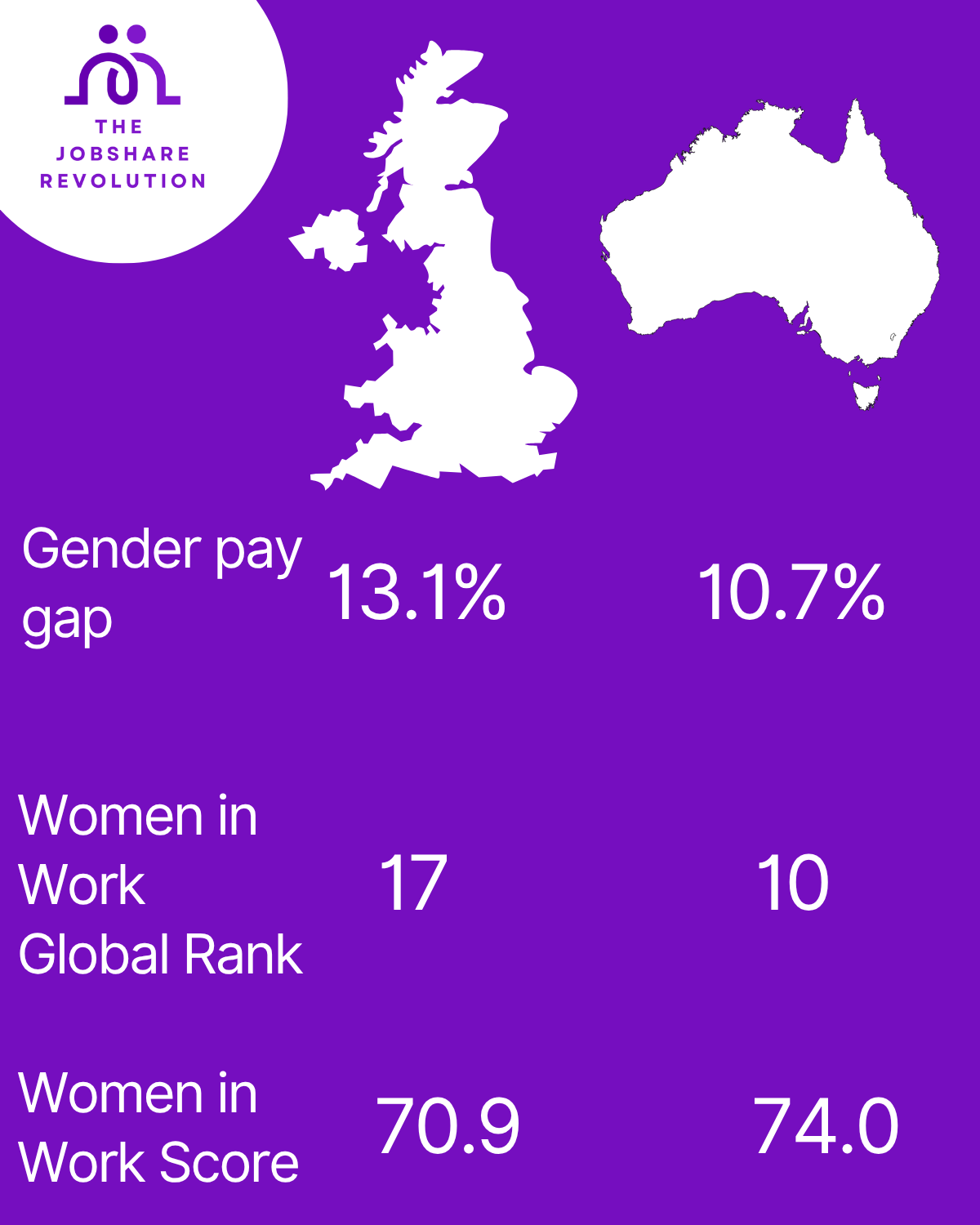
In the UK, the gender pay gap was 13.1% in 2024, still above the OECD average of 12.4%. (Source: ONS: Gender Pay Gap in the UK 2025.)
In Australia, the most commonly reported figure is the WGEA report – which total remuneration gender pay gap of 21.1% — meaning that for every dollar a man makes, a woman earns 79 cents, a difference of $28,356 over the course of a year. (Source: WGEA: Australia's Gender Equality Scorecard 2024-25.)
Unfortunately, this comes with an important caveat. The headline gender pay gap figures for the UK and Australia are not directly comparable, because they are measured differently and draw on different parts of the economy. The UK's ONS figures cover all employees across the public and private sectors; Australia's WGEA data primarily relates to private sector employers. To really understand relative performance, we turned to the ever useful PWC Women In Work Index - one of the most useful international comparison tools available. Published annually, the Index covers five key indicators — female labour force participation rate, gender participation rate gap, female full-time employment rate, female unemployment rate and the gender pay gap — measuring progress towards gender equality in the labour market across 33 OECD countries. Crucially, because it uses the same methodology and data sources for every country, it allows for genuine cross-country comparison.
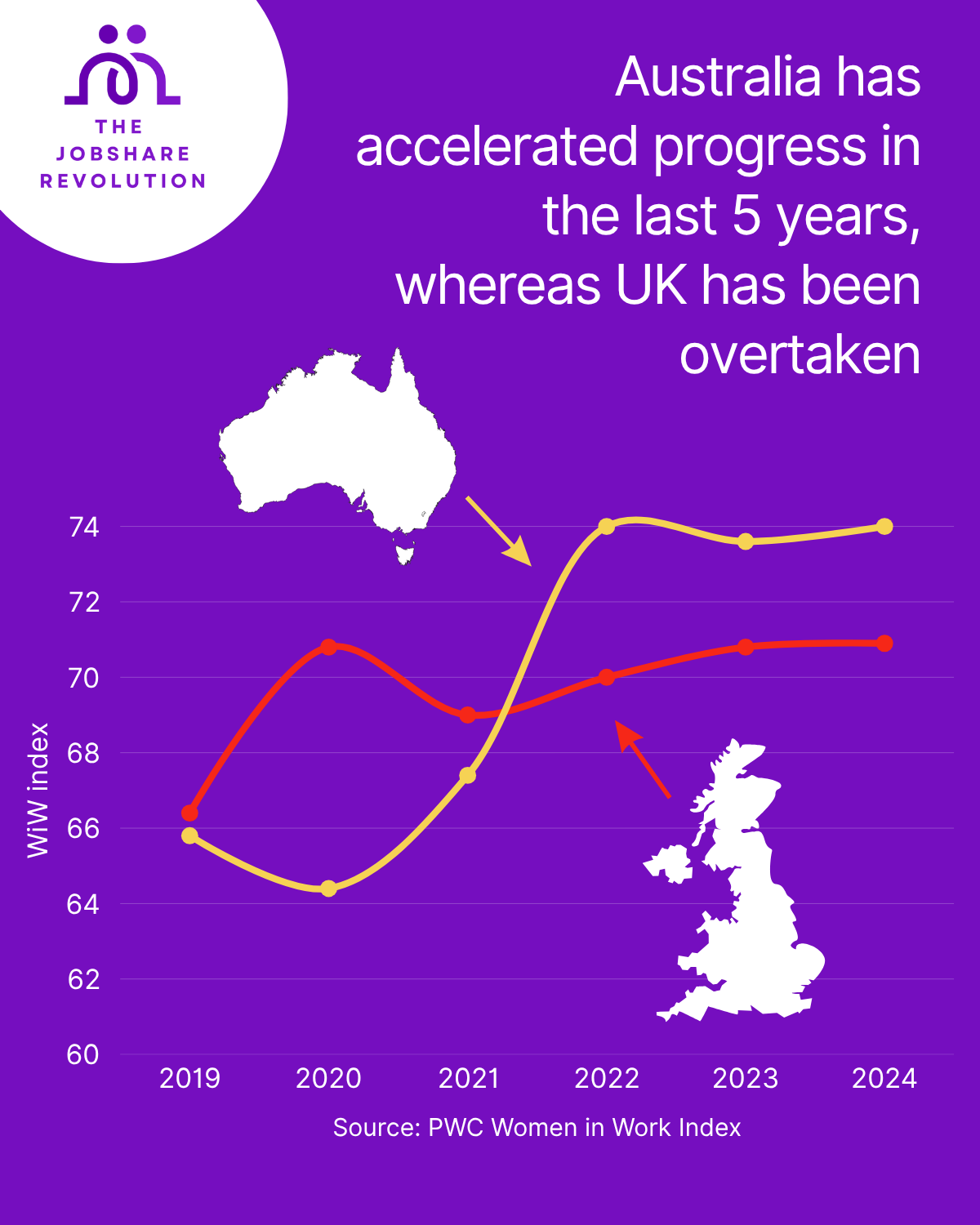
On this index, Australia comes out on top. The UK ranks 17th out of 33 countries in the latest Index, while Australia is in 10th place, having made some significant progress in recent years.
But in both countries, there remains a stubborn gender pay gap. 10.7% for the UK and 13.1% in Australia.
Interestingly, Australia has a lower full-time employment rate for women (implying more women working part-time) and a stronger paygap. Part-time working is often a contributor of pay gap across countries, because part-time roles are typically less well paid, so this does imply that the part-time penalty in Australia is lower.
Both UK and Australia have made progress on gender pay over the recent years, Australia’s progress has accelerated over the last 5 years (and we eagerly await an upcoming report on the impact of parental leave in Australia and the impact it’s had on driving equity, soon to be published by the Global Institute for Women’s Leadership).
What the PwC Index ultimately tells us is that both countries are making progress — but neither is moving fast enough. The latest data suggests it will take almost half a century to close the gender gap across the OECD at the current pace of change. Structural solutions — not incremental policy tweaks — are what's needed. And job sharing, as we'll explore, is one of the most powerful structural tools available. Source: PwC Women in Work 2025 full report.
The legislative landscape: similar direction, different mechanisms
Both the UK and Australia have taken meaningful legislative steps to strengthen workers' rights to flexible working in recent years — though they've gone about it differently.
In the UK, the Employment Relations (Flexible Working) Act 2023 came into effect on 6 April 2024, making it a legal right for employees to make a statutory request for flexible working from day one of their employment. Employees can now make two flexible working requests in any 12-month period, and employers must respond within two months and consult with the employee before rejecting any request.
Australia's Fair Work Act takes a similar approach, giving certain employees — carers, parents of school-aged children, employees over 55, and those experiencing domestic violence — a legal right to request flexible working arrangements. Employers must respond in writing within 21 days and can only refuse on 'reasonable business grounds.' Australia has also introduced a right to disconnect under the Fair Work Legislation Amendment Act 2024, which allows employees to refuse to monitor, read, or respond to work contact outside of their working hours.
Both frameworks represent significant progress. But in both countries, the gap between legislation and lived reality remains wide. The right to request flexible working is not the same as the right to have it — and job sharing, in particular, still too often depends on finding the right manager, the right organisation and the right moment.
Job sharing specifically: policy versus practice
This gap between policy and practice is where the similarities between Australia and the UK become most striking — and most frustrating.
In Australia, 87% of private sector employers had a formal policy or strategy on flexible working arrangements in 2023-24. Among the options offered, job sharing was available to 44% of managers and 51% of non-managers. And in the Australian Public Service, 80% of APS Employee Census respondents accessed some form of flexible working arrangement in 2025, up from 71% in 2020. Sources: WGEA Gender Equality Scorecard 2024-25; APSC APS Employee Census.
And yet, despite those headline numbers, the WGEA data reveals a telling gap: while all reporting practices now have formal flexible work policies, the gap between policy and genuine role redesign remains stark. In the architecture and design sector — an sector which has had more detailed analysis — only four of 29 reporting practices have designed management roles to be performed part-time, and only two incorporate job sharing into their job design and advertising. This pattern is likely to be representative of the broader picture across Australian industries: flexible work policies are widespread, but the structural redesign of roles to make job sharing genuinely accessible has barely begun.
In the UK, we see precisely the same pattern. Job sharing is increasingly recognised as a valuable tool, but it remains far more common at junior and middle levels than at senior leadership. The assumption that certain roles simply cannot be done part-time — or that job sharing is too complicated to manage — persists in many organisations, despite overwhelming evidence to the contrary.
How common is job sharing actually — and how do the two countries compare?
One of the most striking things about job sharing, in both the UK and Australia, is the gap between the appetite for it and the reality of who is actually doing it. The data on prevalence is sobering — but in the UK at least, 2025 has brought some genuinely encouraging signs of momentum.
After a decline in the prevalence of job sharing in the UK in the years following the pandemic, 2025 has been a pivotal turning point, with a 41% increase in the number of job sharing contracts in the UK — recent estimates now suggest there are around 120,000 people on job sharing contracts, up from under 90,000 just a year earlier. As we explored in our 2025: The Year of the (Job)Share blog, this is a significant shift — and one that reflects a broader cultural change in how organisations and employees are thinking about flexible work.
In Australia, directly comparable data on job sharing contracts is harder to come by — Australian workforce surveys do not track job sharing as a distinct employment category in the way the ONS does in the UK. Anecdotal evidence would suggest that it has a similar level of prevalence as the UK – with a concentration of jobsharing in more junior roles.
What both countries share is this: job sharing remains dramatically underutilised relative to both its potential and the demand for it. The structural barriers — roles not designed for it, managers not trained to support it, matching infrastructure that doesn't yet exist at scale — are strikingly similar on both sides of the world. The UK's 2025 resurgence offers a genuine roadmap for what's possible when those barriers start to come down.
When job sharing hits the headlines: the Australian political story
One of the most exciting and inspiring developments in Australia's job sharing story was the attempt by Lucy Bradlow and Bronwen Bock to take the concept somewhere it has never gone before: federal politics.
We had the privilege of speaking with Lucy and Bronwen on the Jobshare Stories podcast — and their ambition was nothing short of remarkable. Lifelong friends from Melbourne, they launched their campaign to jointly run as the independent candidate for the electorate of Higgins, and later as Senate candidates for Victoria under their newly formed Better Together Party.
Their proposed model was a 'week-on, week-off' arrangement, with a handover at the end of each week, a shared email address and diary, and joint decisions on how they vote — designed to be cost-neutral for taxpayers, with the MP salary split between them. Their motivation? Like many Australians, neither was in a position to be in a 24/7 role, travelling to Canberra for 22 weeks a year. And their argument goes beyond personal circumstance: they want to change the way things are done in Australia — challenging the status quo to allow Parliament to better represent the Australia we live in, and allow more women to take up space in the corridors of power.

Lucy Bradlow & Bronwen Bock - jobshare trailblazers
Ultimately, their campaign hit too many timing stumbling blocks and they were unable to challenge the legal framework prior to the election – but theirs was a bold and important idea, which challenged the system and caused others to think differently. It speaks directly to something we hear again and again in our work at The Jobshare Revolution: the structures of our most powerful institutions were built for a particular kind of worker — one without caring responsibilities, without competing demands, and without a life that requires any accommodation. Job sharing is, at its heart, a challenge to that assumption.
Having a spotlight shone on jobsharing – from one of the worlds most famous feminists
As huge jobshare advocates, and hosts of the leading podcast shining a light on jobsharing, Jobshare Stories, we’re always thrilled to see jobsharing being celebrated. We were thrilled last year when non other than Julia Gilliard – the former Prime Minister of Australia – featured jobsharing on her podcast “A Podcast of One’s Own”. This podcast is produced by the Global Institute for Women's Leadership at the Australian National University and in an episode released in October 2025, she interviewed “Naomi and Catherine” who work in the UK Foreign Commonwealth and Development Office — part of the UK's national security community. They are both mothers, and they are in a long-term jobshare. They spoke to Julia Gillard about the stereotypes and misconceptions of their work, what it's really like for women, diversity in national security, and how they make job sharing work in such an important area. (You can listen to the episode here.)
The episode is a quiet but powerful statement: if job sharing can work in national security, it can work anywhere. And it speaks to something Julia Gillard — Australia's first and only female Prime Minister, and one of the world's most prominent voices on gender equality — clearly believes: that the way we structure work is a feminist issue, and that jobsharing is part of the solution.
The common thread: changing the system, not the people
What strikes me most, reflecting on my time in Australia and the conversations I've had on both sides of the world, is how consistent the human experience is. The parents who want to stay in senior, meaningful work. The experienced professionals who don't want to choose between impact and wellbeing. The organisations that talk about flexibility but haven't yet redesigned the roles that make it real.
The problem is not the people. The problem — as we always say at The Jobshare Revolution — is the system. And the solution isn't to ask people to contort themselves to fit broken structures. It's to build better ones.
Jobsharing is one of the most powerful structural tools available. For employees, flexible work — and job sharing in particular — can provide a better work-life balance, improved wellbeing, and increased job satisfaction. For employers, it can improve retention and recruitment, increase productivity, and reduce absenteeism and turnover. The evidence is there, in both countries. What's needed now is the will — at every level, from HR policy to parliament — to act on it.
Australia and the UK are having the same conversation. The question is who will move fastest to turn that conversation into change.
Want to find out more?
To hear more inspiring job share stories from both sides of the world, search for Jobshare Stories wherever you get your podcasts.
Read our blog about Lucy Bradlow and Bronwen Bock — Australia's pioneering job share political candidates — here.
Listen to Julia Gillard's A Podcast of One's Own episode featuring the UK national security job sharers here.
To find out more about how job sharing could transform your organisation, get in touch at hello@TheJobshareRevolution.co.uk.
